EDITORIAL
The Future of Dentistry: Integrating Precision, Prevention, and Digital Innovation in Oral Healthcare
Fatima Ali1*
1School of Biomedical Sciences (Biological Sciences), University of ROME, Italy, Pakistan
*Correspondence: Fatima Ali (fmohsinali7@gmail.com)
Acknowledgement: None;
Competing Interests: The author declared no competing interests;
Grant Support and Funding Source: No external funding source;
Study Ethical Approval: Not Applicable;
Consent for Participation and Publication: Not Applicable;
Availability of Data and Materials: Not Applicable;
Use of Artificial Intelligence: Figure 1 has been created by using OpenAI ChatGPT (GPT-4o) solely for the purpose of better illustration and scientific understandings. The corresponding author declared that no other artificial intelligence or AI-assisted tools were used anywhere in this manuscript;
Authors’ Contribution: FA: Conception, literature search, drafting, writing, critical revision and final approval as per ICMJE.
Received: 04 September, 2026 Revised: 18 September, 2026 Accepted: 22 September, 2026 Published: 30 September, 2026
ABSTRACT
Current dental practice is changing and old diagnostic and treatment methods are being complemented by precision medicine, prevention, artificial intelligence and digital technologies. The organization of oral healthcare has been based on the management of disease and clinical signs. The management of established disease, restoring carious lesions, treating periodontal disease after clinical signs appear, and replacing missing teeth, has long been the basis for organizing oral healthcare. The real question is how can dentistry adapt to the technological developments without sacrificing the clinical skills, patient interaction, ethics and prevention that makes for good health care. The future will rely not only on the ability to implement more advanced technologies, but evidence-based application of these technologies to build a more predictive, personalized, accessible and patient-centered oral healthcare system.
Keywords: Dental Plaque; Health Behavior; Oral Hygiene; Periodontal Diseases; Precision Medicine.
INTRODUCTION
The paradigm shift in dentistry has been from restorative to prevention and risk-based dental management. The etiology of dental caries or periodontal disease is multifactorial, including biological, behavioral, environmental, socioeconomic and systemic factors, as well as many other factors involved in tooth loss and various oral complications 1. Effectively addressing these determinants and not the visible consequence may lead to continued treatment requirements and re-emergence of disease 2. Rather than applying a uniform set of assumptions to all patients, clinicians now have the ability to increasingly include individual risk profiles in the field of prevention and treatment planning. Some future salivary biomarkers, microbiome analysis, genetic information, clinical history, behavioral characteristics, imaging data, and longitudinal patient information may help in the future to more accurately predict disease susceptibility 3.
This does not mean that all patients need to undergo extensive molecular testing. Instead, precision dentistry should be viewed as an approach to tailor the type and level of intervention to the patient's risk 4. For patients at high risk for caries, more frequent preventive visits, tailored fluoride recommendations, dietary advice, and more intensive monitoring may be warranted, and for low-risk patients, less intensive monitoring or treatment may be adequate 5. The same rules can be used for periodontal and oral cancer screening. Prevention therefore becomes a more structured component of clinical care. It ends up being planned, quantifiable and personalized section of clinical care.
ARTIFICIAL INTELLIGENCE (AI)-DRIVEN DIAGNOSTIC ENVIRONMENT
AI is increasingly being applied in dentistry. It can be used in the study of radiographic interpretation, caries, periodontal diagnosis, orthodontic treatment planning, implantology, prosthodontics, oral pathological diagnosis and prediction of treatments 6. AI-powered image analysis could be useful for detecting subtle changes that might not be noticed during a typical physical exam. It is possible to use machine-learning algorithms to analyze large sets of radiographs and other clinical images, which could help identify and classify dental caries, periapical lesions, bone loss, impacted teeth, and other abnormalities 7. AI should function as a clinical aid rather than a replacement for the dentist. There are other factors in addition to image recognition that play a role in diagnostic accuracy, including clinical history, physical exam, symptoms, differential diagnosis and patient-specific context 8. An algorithm can detect an abnormality but the clinician must follow-up to assess its clinical significance and decide if intervention is warranted.
The distinction between AI-assisted assessment and clinical decision-making raising additional ethical concerns. Who is responsible when an algorithm makes an incorrect recommendation? What should be done to secure the data of patients? Do algorithms work the same in all populations, imaging systems and clinical settings? What are the ways to detect biased or poorly validated models?
DIGITAL DENTISTRY AND THE CONNECTED CLINICAL WORKFLOW
Digital dentistry has already revolutionized the planning and provision of many dental procedures. Numerous aspects of clinical practice have been changed by intraoral scanners, digital impressions, CAD/CAM systems, 3D imaging, digital smile design, computer-guided implant placement, and 3D printing 9. These technologies can improve workflow efficiency, communication, and treatment planning. A digital workflow can enhance communication and collaboration between dentists, specialists, dental laboratories and patients. Digital image data can be stored, transferred, compared over time, and used in care planning 10.
Three-dimensional imaging can offer anatomical data that may not be easily gained by conventional two-dimensional imaging methods. Digital technologies integration can ultimately culminate in a continuous clinical workflow that integrates clinical information from examination to planning, manufacturing, treatment and follow-up 11. Rather than standalone digital solutions, dentistry is transitioning to digital ecosystems. However, digitalization also introduces implementation challenges. Equipment may be costly, software platforms may not always be compatible, and clinicians need to be trained. Digital transformation should thus not be an end goal itself. Technology should be implemented where it has been shown to enhance the accuracy, efficiency, safety, accessibility or patient experience.
PERSONALIZED PERIODONTAL CARE
Precise and preventative care are key applications in periodontology. The presence of pathogens is not the only cause of periodontal diseases. Host response, systemic health, smoking, metabolic factors, oral hygiene, socioeconomic factors and behavioral patterns all affect the development and progression of disease 12. Individually tailored risk prediction and long-term monitoring will play an increasing role in the future in periodontal care. Clinicians could help identify patients with increased risk of progression with the use of digital periodontal charts, standardized imaging, biomarkers, and automated assessment tools. Mobile health (mHealth) and wearable technologies also offer potential to strengthen behavioral interventions by prompting patients, monitoring their oral hygiene habits, and encouraging compliance with professional guidance 13. These systems may be able to change the way periodontal maintenance is currently practiced, moving from a largely clinic-based system to a continuous system for management of the disease.
TELEDENTISTRY AND DEMOCRATIZING ORAL HEALTHCARE
Teledentistry is another important aspect of the digital transformation. Technologies such as remote consultation, digital communication, smartphone imaging and virtual follow-up will aid in bringing oral health to people who have geographical, financial or mobility issues 14. Teledentistry may be especially useful for initial assessment, post-operative follow-up, oral health education, triage, and in facilitating communication between the primary care provider and specialists 15. For people in underserved communities, remote systems can be a way for patients to access specialist care without having to make multiple long trips. Teledentistry should be used in conjunction with, not instead of, clinical care, however. Therapy for many oral diseases necessitates direct examination, evaluation, procedures and/or laboratory investigations. The best type of model is, therefore, likely to be hybrid – a mix of virtual and in-person care based on clinical need.
HUMAN-CENTERED DENTISTRY IN THE DIGITAL ERA
As digital technologies become a bigger part of dentistry, the human side of care remains equally important. Dentistry still depends on trust, communication, professional judgment, and understanding the individual needs of each patient. For this reason, digital tools should support the dentist–patient relationship rather than replace it. This also means preparing dental professionals to use new technologies responsibly while maintaining patient privacy, ethical practice, and effective communication.
The Human Factor of the Future of Dentistry: One of the biggest hurdles of digital dentistry is maintaining the human elements of care. Dentistry has a lot to do with trust, decisions, communication, anxiety, pain, aesthetics and a lot of personal and private matters. Patients experience oral healthcare primarily through interactions with healthcare professionals rather than through the underlying technology. Technology should, therefore, enhance the dentist/patient relationship, not diminish it. Digital visualization can play a role in communicating treatment options to patients 16. Decision-making might be improved by the use of simulation tools. By using electronic records, continuity of care can be enhanced. AI can help to streamline administration and offer decision support. These benefits can provide more time for the health care provider to dedicate to communication and personalized care. The postgraduate dentist will then need a wider range of skills. The technical skills will be necessary, but will require a combination of data literacy, critical assessment of AI outputs, communication skills, ethics and knowledge of digital health systems.
Dental Education Should Adapt to Technology: Dental education must adapt to technological changes in clinical practice. Future curricula should include digital imaging, CAD/CAM workflow, digital diagnosis with the aid of artificial intelligence, data interpretation, digital ethics, cybersecurity, and evidence-based assessment of new technologies. Most importantly, students need to not only use technology, but to ask questions of technology. All digital tools must be assessed by their evidence, limitations, clinical relevance, cost, and risk. There will be continuing professional development that will also be significant. New technologies that are deployed now could be obsolete in a couple of years. Dentists will therefore have to embrace lifelong learning as an integral part of their profession.
Data, Privacy, and Ethical Responsibility: As digital dentistry expands, vast amounts of patient data will be created. The use of radiographs, photographs, intraoral scans, genomic data, electronic health records, treatment histories, and behavioral data may be increasingly integrated within clinical systems 17. This not only opens the door to research and personalized care but also immense responsibility. Confidentiality must be key and not be compromised. Data should be gathered for valid reasons, be stored safely and processed transparently. Patients should be aware of how their information is being used, including if it is being used to enhance or train AI systems. Algorithmic bias is also a topic that must be tackled in ethical digital dentistry. A system that is trained mainly based on data from a particular population may not perform equally well in another population. Thus, validation in different groups should be made a standard requirement prior to broad clinical use.
INTEGRATED MODEL OF ORAL HEALTHCARE
No single technology ought to shape the future of dentistry. It has the greatest potential in the area of integration. Consider a model where clinical examination, digital radiographs, intraoral scans, periodontal measurements, medical history, and behavioral information, and appropriate biomarkers, are integrated into a longitudinal record for a patient. These systems might be able to detect the changing patterns of risk, and the dentist could use these systems to interpret the results to create an individual prevention and treatment plan. Individual patients would be able to access a customized educational program via digital means, see specific outcomes remotely and return to targeted professional care (Figure 1).
CONCLUSION
Precision, prevention, and digital innovation are central to the evolving model of dental care. New advancements in AI, digital imaging, CAD/CAM, 3D printing, teledentistry, biomarkers, and personalized risk assessment are changing the way oral disease is predicted, prevented, diagnosed, and treated. There may be a paradigm shift in the way precision dentistry is perceived, rather than solely in the technology used. Dentistry should shift from the disease care model, where the disease is already clinically established, to a model anticipating disease risk, preventing progression of disease, and ongoing care for oral health. Interprofessional collaboration between dental and medical teams will be essential to fully realize the benefits of predictive, preventive, and personalized oral healthcare. Future dentistry doesn't have to be only more digital; it can be preventive, precise, accessible, and patient-centered, if innovation is evidence-led, equity-focused, and ethically grounded, and is focused on human care.
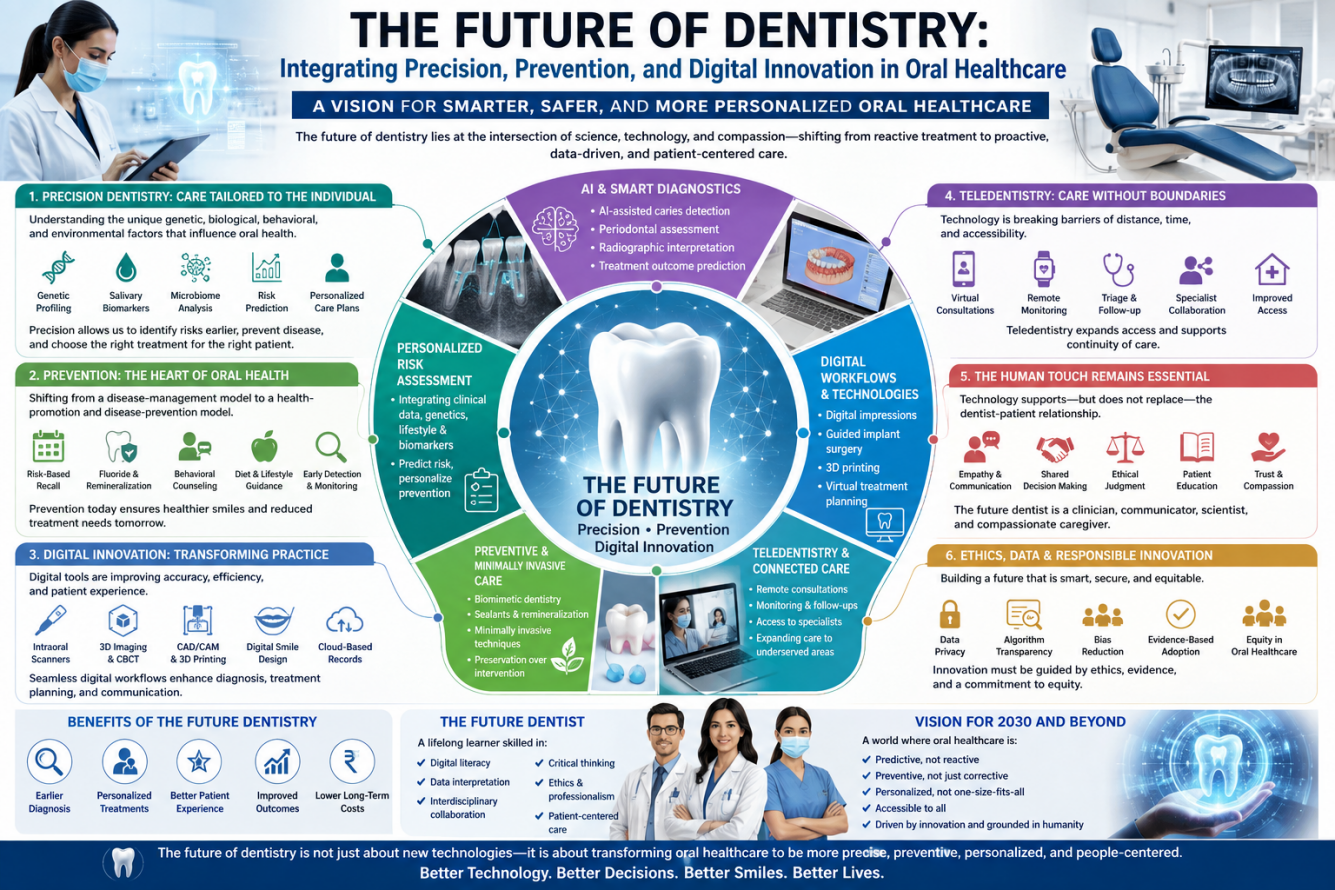
Figure 1: Future of Dentistry: Integrating Precision, Prevention, and Digital Innovation in Oral Healthcare 18. The figure illustrates an integrated vision for the evolution of modern dentistry to precision, prevention, and digitally supported care. It emphasizes on AI, custom risk assessment, digitization of processes, teledentistry, less invasive interventions and connected patient care. Ethical data use, professional judgment, patient education and equitable access to oral health care are also key aspects of the framework. The components show a progression from the old concept of treatment to a new concept of treatment, prediction, prevention, and personalized patient care.
References
- Meyer F, Zur Wiesche ES, Amaechi BT, Limeback H, Enax J. Caries etiology and preventive measures. Eur J Dent. 2024;18(03):766-76. https://doi.org/10.1055/s-0043-1777051
- Schwendicke FA, Samek W, Krois J. Artificial intelligence in dentistry: chances and challenges. J Dent Res. 2020;99(7):769-74. https://doi.org/10.1177/0022034520915714
- Lee SJ, Poon J, Jindarojanakul A, Huang CC, Viera O, Cheong CW, et al. Artificial intelligence in dentistry: Exploring emerging applications and future prospects. J Dent. 2025;155:105648. https://doi.org/10.1016/j.jdent.2025.105648
- Najeeb M, Islam S. Artificial intelligence (AI) in restorative dentistry: current trends and future prospects. BMC Oral Health. 2025;25(1):592. https://doi.org/10.1186/s12903-025-05989-1
- Fatima A, Shafi I, Afzal H, Díez ID, Lourdes DR, Breñosa J, et al. Advancements in dentistry with artificial intelligence: current clinical applications and future perspectives. Healthcare. 2022;10(11):2188. https://doi.org/10.3390/healthcare10112188
- Tandon D, Rajawat J, Banerjee M. Present and future of artificial intelligence in dentistry. J Oral Biol Craniofac Res. 2020;10(4):391-6. https://doi.org/10.1016/j.jobcr.2020.07.015
- Panahi O, Ezzati A, Zeynali M. Will AI replace your dentist? The future of dental practice. On J Dent Oral Health. 2025;8(3):2025. https://doi.org/10.33552/OJDOH.2025.08.000690
- Joda T, Bornstein MM, Jung RE, Ferrari M, Waltimo T, Zitzmann NU. Recent trends and future direction of dental research in the digital era. Int J Environ Res Public Health. 2020;17(6):1987. https://doi.org/10.3390/ijerph17061987
- Shan T, Tay FR, Gu L. Application of artificial intelligence in dentistry. J Dent Res. 2021;100(3):232-44. https://doi.org/10.1177/0022034520969115
- Khurshid Z. Digital dentistry: transformation of oral health and dental education with technology. Eur J Dent. 2023;17(04):943-4. https://doi.org/10.1055/s-0043-1772674
- Suese K. Progress in digital dentistry: The practical use of intraoral scanners. Dent Mater J. 2020;39(1):52-6. https://doi.org/10.4012/dmj.2019-224
- Dipalma G, Inchingolo AM, Inchingolo F, Palumbo I, Riccaldo L, Guglielmo M, et al. The precision paradigm in periodontology: a multilevel framework for tailored diagnosis, treatment, and prevention. J Pers Med. 2025;15(9):440. https://doi.org/10.3390/jpm15090440
- Kikuchi T, Hayashi JI, Mitani A. Next-generation examination, diagnosis, and personalized medicine in periodontal disease. J Pers Med. 2022;12(10):1743. https://doi.org/10.3390/jpm12101743
- Talla PK, Allison P, Bussières A, Rodrigues A, Bergeron F, Giraudeau N, et al. Teledentistry for improving access to, and quality of oral health care: overview of systematic reviews and meta-analyses. J Med Internet Res. 2025;27(1):e65211. https://doi.org/10.2196/65211
- Hamdy TM. Teledentistry: a comprehensive review of applications, challenges, and future directions. Discov Med. 2025;2(1):201. https://doi.org/10.1007/s44337-025-00445-z
- Batra P, Tagra H, Katyal S. Artificial intelligence in teledentistry. Discoveries. 2022;10(3):153. https://doi.org/10.15190/d.2022.12
- Schwendicke F, Uribe SE, Walji M, Lam W, Tichy A. Electronic health records in dentistry: relevance, challenges and policy directions. Int Dent J. 2025;75(6):103964. https://doi.org/10.1016/j.identj.2025.103964
- OpenAI. ChatGPT (GPT-4o) [Computer Software]. 2026 [cited 2026 Aug 21]. Available from: https://chatgpt.com

Journal of Dentistry and Oral Sciences Research, J Dent Oral Sci Res 2026:1(1), p1-4 (jdosr.org)
© 2026 Authors. This work is published by Multidisciplinary Scholarly Advancement and Research MSAR Institute. The full terms of Journal Publishing policy is available at https://jdosr.org/index.php/jdosr/publishing-policy and incorporate the Creative Commons Attribution – Non Commercial (CC BY, NC 4.0) License https://creativecommons.org/licenses/by-nc/4.0/. By accessing the work you hereby accept the Terms. Non-commercial uses of the work are permitted without any further permission, provided the work is properly attributed. Publisher’s Note: MSAR Institute remains neutral with regard to jurisdictional claims in published maps and institutional affiliations, and assumes no liability for the scientific accuracy or clinical efficacy of the content herein, as they rest entirely with the authors.