LETTER TO EDITOR
Periodontal Disease and Its Relationship with Oral Hygiene Practices Among Adults
Kemia Batty1*
1Alumna, Department of Medicine, Monash University, Australia
*Correspondence: Kemia Batty (kemiabatty@gmail.com)
Acknowledgement: None;
Competing Interests: The author declared no competing interests;
Grant Support and Funding Source: No external funding source;
Study Ethical Approval: Not Applicable;
Consent for Participation and Publication: Not Applicable;
Availability of Data and Materials: Not Applicable;
Use of Artificial Intelligence: Figure 1 has been created by using OpenAI ChatGPT (GPT-4o) solely for the purpose of better illustration and scientific understanding. The corresponding author declared that no other artificial intelligence or AI-assisted tools were used anywhere in this manuscript;
Authors’ Contribution: KB: Conception, literature search, drafting, writing, critical revision and final approval as per ICMJE.
Received: 04 September, 2026 Revised: 18 September, 2026 Accepted: 19 September, 2026 Published: 30 September, 2026
Dear Editor,
Periodontal disease is one of the most common chronic oral diseases globally and is a significant, but often overlooked public health problem. Despite the improvement in the clinical management of periodontal disease, the burden of this disease remains primarily caused by avoidable behavioural and environmental risk factors 1. Of these, oral hygiene practices are an important one. Thus, daily oral hygiene behaviour and periodontal health are not only related through the individual's mouth but also significant to population level disease prevention. Periodontal disease is a result of the interaction of microbial biofilms and inflammation of the host. The presence of dental plaque around the gum line can lead to inflammation of the gums, and an ongoing imbalance in dental flora can play a role in the deterioration of gums in susceptible individuals. But the symptoms and course of disease are very different in adults 2. This association between oral hygiene and periodontal outcomes may be changed/modified by age, smoking, diabetes, socioeconomic status, dietary pattern, access to dental services, use of medication, and genetic susceptibility 3. Therefore, oral hygiene should be viewed in the context of the individual risk factor and not in isolation.
One special case to consider is interdental cleaning. Plaque can build up in the gaps between teeth and is hard to clean with standard brushing 4. Properly chosen oral cleaning tools such as dental floss, interdental brushes and other tools can play a role in good plaque control 5. Recommendations, however, should be personalized as there is a considerable variation in interdental anatomy in different patients. Where periodontal disease has caused an increase in interdental space, interdental brushes may prove beneficial and where contacts are very tight floss may be better 6. Professional instruction is, therefore, necessary for any recommendations for good oral hygiene to have a meaningful effect in terms of behaviour change. One of the key issues is the difference between knowledge and practice. While many adults know that not caring for their teeth and gums correctly can lead to gum disease, some don't engage in preventive measures consistently 7. People might know how to brush, but not follow proper routines due to time, motivation, work, fear of the dentist, money, or a lack of understanding of oral care 8. The disconnect between knowledge and practice indicates a possible lack of effectiveness of traditional health education. Behavioural barriers should be addressed as well as creating sustainable routines in the context of preventive interventions.
The involvement of professional dental care should also be taken into account. Preventive maintenance care allows for early detection of signs of gingival inflammation, periodontal pockets, attachment loss, and other risk factors 9. Deficiencies in home-care practices can be identified through professional assessment, and individual instruction can be provided based on these results 10. But preventive dentistry shouldn't solely rely on appointments. Many of the things you do between visits are important to your periodontal health. Thus, any model of prevention must be able to enable patients to actively participate in their oral health. The link between periodontal disease and systemic health re-emphasizes the need for prevention. Studies have found that inflammation of the gums has been linked to some other systemic diseases, and may also have similar risk factors to cardiometabolic diseases 11. A poor oral health can exacerbate poorly controlled diabetes, and vice versa, periodontal inflammation may make it difficult to manage diabetes. Diabetes is a good example of the bidirectional link between oral and systemic health. The interactions underscore the importance of better links between dental and general health care providers.
Public health approaches should therefore shift from assuming periodontal disease is predominantly a clinical problem to the individual. The relationship between socioeconomic inequalities and oral hygiene practices and access to preventive care can be strong 12. People of disadvantaged groups may have less access to dental professionals, have increased behavioural risk factors, decreased health literacy, and financial constraints on buying oral hygiene products 13. Unsupportive structural changes are unlikely to have large-scale and lasting benefits if not accompanied by advice on oral hygiene. Community based prevention needs to be emphasized. Workplace, school, community center and/or primary healthcare education programs can encourage proper brushing and interdental cleaning. Digital health technologies can also offer new avenues for behavioural support. Oral health apps, reminders, educational videos, and virtual consultations may help provide reminders and tailored feedback on oral hygiene 14.
One other region that requires focus is measuring oral health behaviour in research. Self-reported brushing frequency and dental attendance are used in many studies, and are subject to recall and social desirability bias. The holistic periodontal prevention program should include patient education, low-cost oral health services, use of easily available preventive products, community education, tobacco-control education, and an integration of oral health into primary healthcare. The future of periodontal care should therefore shift to risk-based personalized prevention. Instead of issuing general recommendations to all adults, clinicians are increasingly mindful of the various clinical risk factors and personal health factors that impact an individual's periodontal status, such as oral hygiene habits, systemic health, smoking, socioeconomic status, and clinical risk. Personalized prevention could lead to better adherence as recommendations are more likely to apply to the patient's specific situation. The relationship between oral hygiene practices and periodontal health is illustrated in Figure 1.
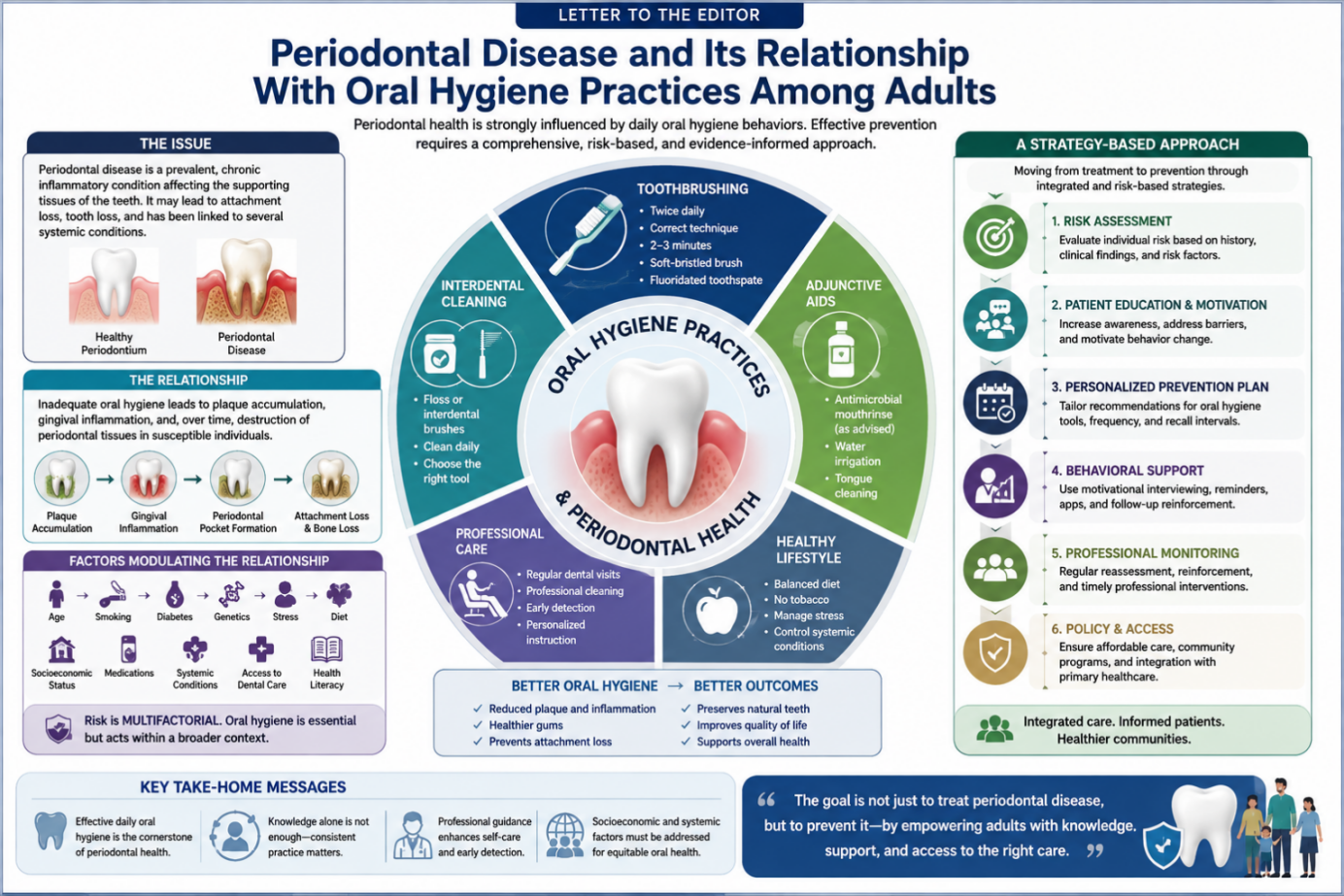
Figure 1: Integrated strategy illustrating the relationship between periodontal disease and oral hygiene practices among adults 15. The figure illustrates how inadequate oral hygiene contributes to plaque accumulation, gingival inflammation, periodontal pocket formation, and subsequent attachment or bone loss. It highlights key preventive practices, including effective toothbrushing, interdental cleaning, appropriate adjunctive aids, professional dental care, and healthy lifestyle behaviours. The strategy emphasizes individualized risk assessment, patient education, behavioural support, professional monitoring, and improved access to care. Overall, the framework promotes a shift from reactive periodontal treatment toward preventive, personalized, and integrated oral healthcare.
In summary, periodontal disease is still a significant public health problem, and much of the disease burden is potentially preventable with proper prevention and maintenance of good oral hygiene. These recommendations (toothbrushing, interdental cleaning, professional monitoring, behavioural support and early intervention) are not isolated but rather are all part of periodontal health.
References
- Darby I. Risk factors for periodontitis & peri‑implantitis. Periodontol 2000. 2022;90(1):9-12. https://doi.org/10.1111/prd.12447
- Isola G, Santonocito S, Lupi SM, Polizzi A, Sclafani R, Patini R, et al. Periodontal health and disease in the context of systemic diseases. Mediators Inflamm. 2023;2023(1):9720947. https://doi.org/10.1155/2023/9720947
- Vilar Doceda M, Petit C, Huck O. Behavioral interventions on periodontitis patients to improve oral hygiene: A systematic review. J Clin Med. 2023;12(6):2276. https://doi.org/10.3390/jcm12062276
- Jakubovics NS, Goodman SD, Mashburn‑Warren L, Stafford GP, Cieplik F. The dental plaque biofilm matrix. Periodontol 2000. 2021;86(1):32-56. https://doi.org/10.1111/prd.12361
- Bevilacqua L, Lorenzon MG, Bjedov M, Costantinides F, Angerame D, Maglione M. Evaluation of the efficacy of inter‑dental brush and dental floss for peri‑implant mucositis: A crossover randomized clinical trial. Int J Dent Hyg. 2024;22(3):779-88. https://doi.org/10.1111/idh.12793
- Bosma ML, McGuire JA, DelSasso A, Milleman J, Milleman K. Efficacy of flossing and mouth rinsing regimens on plaque and gingivitis: a randomized clinical trial. BMC Oral Health. 2024;24(1):178. https://doi.org/10.1186/s12903-024-03924-4
- Ray RR. Periodontitis: an oral disease with severe consequences. Appl Biochem Biotechnol. 2023;195(1):17-32. https://doi.org/10.1007/s12010-022-04127-9
- Butera A, Gallo S, Pascadopoli M, Montasser MA, Abd El Latief MH, Modica GG, et al. Home oral care with biomimetic hydroxyapatite vs. conventional fluoridated toothpaste for the remineralization and desensitizing of white spot lesions: Randomized clinical trial. Int J Environ Res Public Health. 2022;19(14):8676. https://doi.org/10.3390/ijerph19148676
- Rebout F. The Impact of Oral Hygiene Practices on the Prevention of Periodontal Diseases. J Adv Med Pharm Biomed Res. 2026;2(4):332-45. https://doi.org/10.22034/jampbr.2026.582110.1093
- Rowińska I, Szyperska-Ślaska A, Zariczny P, Pasławski R, Kramkowski K, Kowalczyk P. The influence of diet on oxidative stress and inflammation induced by bacterial biofilms in the human oral cavity. Materials. 2021;14(6):1444. https://doi.org/10.3390/ma14061444
- Dunleavy G, Verma N, Raghupathy R, Jain S, Hofmeister J, Cook R, et al. Inequalities in oral health: estimating the longitudinal economic burden of dental caries by deprivation status in six countries. BMC Public Health. 2024;24(1):3239. https://doi.org/10.1186/s12889-024-20652-0
- De Abreu MH, Cruz AJ, Borges-Oliveira AC, Martins RD, Mattos FD. Perspectives on social and environmental determinants of oral health. Int J Environ Res Public Health. 2021;18(24):13429. https://doi.org/10.3390/ijerph182413429
- Warreth A. Dental caries and its management. Int J Dent. 2023;2023(1):9365845. https://doi.org/10.1155/2023/9365845
- Hamdy TM. Teledentistry: a comprehensive review of applications, challenges, and future directions. Discov Med. 2025;2(1):201. https://doi.org/10.1007/s44337-025-00445-z
- OpenAI. ChatGPT (GPT-4o) [Computer Software]. 2026 [cited 2026 Aug 15]. Available from: https://chatgpt.com

Journal of Dentistry and Oral Sciences Research, J Dent Oral Sci Res 2026:1(1), p20-21 (jdosr.org)
© 2026 Authors. This work is published by Multidisciplinary Scholarly Advancement and Research MSAR Institute. The full terms of Journal Publishing policy is available at https://jdosr.org/index.php/jdosr/publishing-policy and incorporate the Creative Commons Attribution – Non Commercial (CC BY, NC 4.0) License https://creativecommons.org/licenses/by-nc/4.0/. By accessing the work you hereby accept the Terms. Non-commercial uses of the work are permitted without any further permission, provided the work is properly attributed. Publisher’s Note: MSAR Institute remains neutral with regard to jurisdictional claims in published maps and institutional affiliations, and assumes no liability for the scientific accuracy or clinical efficacy of the content herein, as they rest entirely with the authors.