
Diagnostic Accuracy of Artificial Intelligence-Assisted Intraoral Imaging for Detection of Early Dental Caries: A Multicenter Clinical Study
DOI:
https://doi.org/10.68041/jdosr.v1i1/03Keywords:
Artificial Intelligence, Dental Caries, Diagnostic Imaging, Diagnosis, Oral, Machine Learning, Photography, DentalAbstract
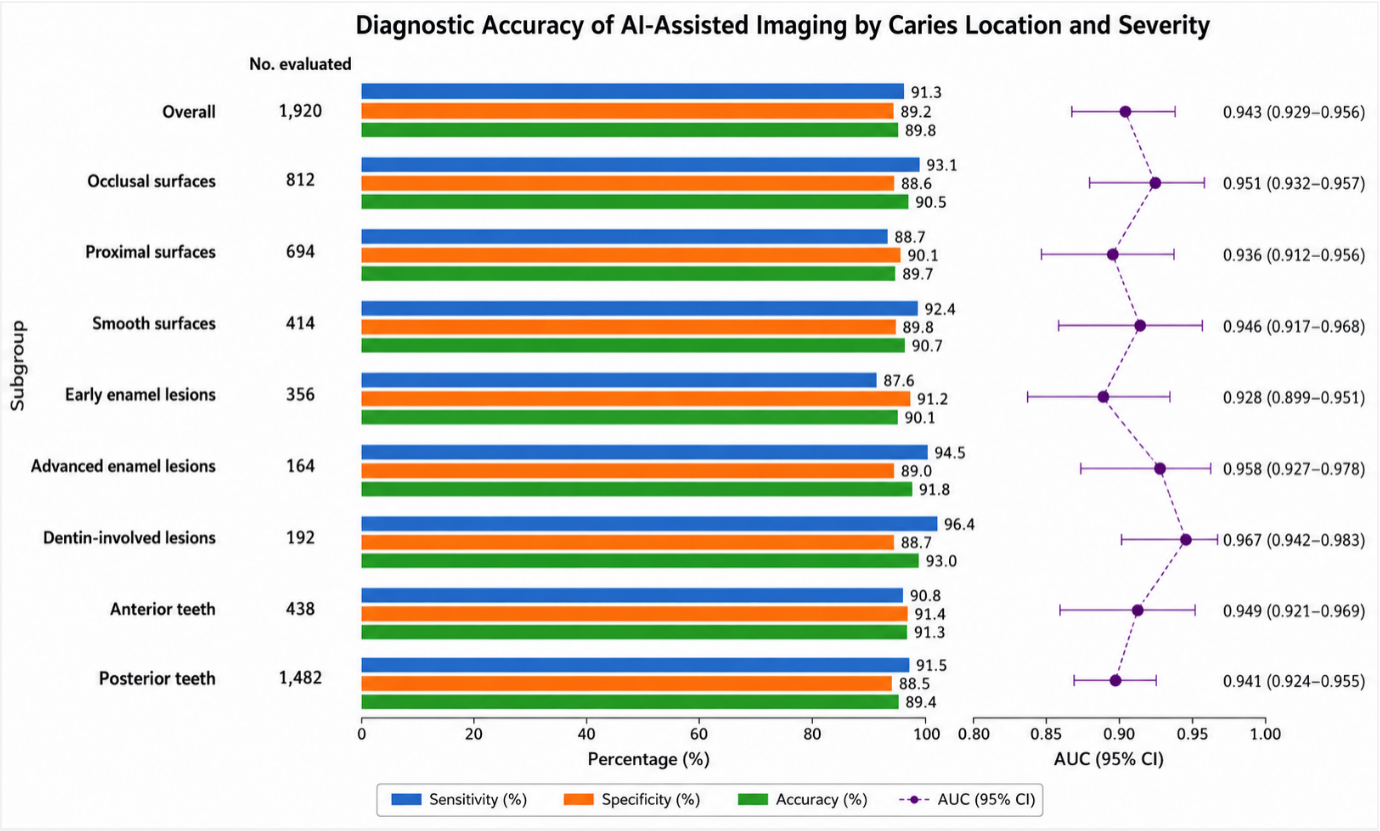
Background: Early detection of dental caries may prevent lesion progression and facilitate minimally invasive treatment. This study aimed to assess the diagnostic performance of artificial intelligence (AI) supported intraoral imaging in the detection of early dental caries in adults. Methods: This multicenter clinical study included 480 adults from three dental centers. A total of 1,920 tooth surfaces were assessed using AI-assisted intraoral imaging and conventional clinical assessment. The sensitivity, specificity, positive predictive value (PPV), negative predictive value (NPV), accuracy, F1 score, Cohen's κ, and area under the receiver operating characteristic curve (AUC) were evaluated. Results: The reference standard identified 520 (27.1%) surfaces with early dental caries. AI-assisted intraoral imaging showed 91.3% sensitivity (95% CI: 88.6–93.5%), 89.2% specificity (95% CI: 87.5–90.7%), 75.9% PPV, 96.5% NPV, and 89.8% overall accuracy. The AUC was 0.943 (95% CI: 0.929–0.956) and Cohen's κ was 0.747, suggesting good agreement with the reference tests. The sensitivity was highest for lesions involving dentin (96.4%) and was satisfactory for early enamel lesions (87.6%). AI-assisted intraoral imaging had a significantly higher sensitivity (91.3% vs. 76.5%) and AUC (0.943 vs. 0.851; both P<0.001) than conventional clinical evaluation. The mean diagnostic interpretation time was also lower when using AI-assisted intraoral imaging (0.42 ± 0.11 vs. 0.68 ± 0.17 min/surface; P<0.001). Conclusion: AI-assisted intraoral imaging showed high diagnostic accuracy and good agreement with the reference standard for early dental caries detection. Further prospective validation in different populations and clinical settings is warranted before routine widespread use.
References
1. Wang S, Jiang J, Li J, Mou J, Liu N, Yuan J, et al. The global, regional, and national burden of oral disorders in 204 countries and territories, 1990–2021, and projections to 2050: A systematic analysis for the Global Burden of Disease Study 2021. Regenesis Repair Rehabil. 2025;1(3):56-63. https://doi.org/10.1016/j.rerere.2025.07.001
2. Hamilton AR, Ricketts D. Management of deep caries. Br Dent J. 2026;240(5):357-364. https://doi.org/10.1038/s41415-025-9350-7
3. Frencken JE, Peters MC, Manton DJ, Leal SC, Gordan VV, Eden E. Minimal intervention dentistry for managing dental caries – a review: Report of a FDI task group. Int Dent J. 2020;62(5):223-243. https://doi.org/10.1111/idj.12007
4. Macey R, Walsh T, Riley P, Glenny AM, Worthington HV, O'Malley L, et al. Visual or visual-tactile examination to detect and inform the diagnosis of enamel caries. Cochrane Database Syst Rev. 2021;2021(6):CD014546. https://doi.org/10.1002/14651858.CD014546
5. Kwiatek J, Lesna M, Piskórz W, Kaczewiak J. Comparison of the diagnostic accuracy of an AI-based system for dental caries detection and clinical evaluation conducted by dentists. J Clin Med. 2025;14(5):1566. https://doi.org/10.3390/jcm14051566
6. de Magalhães AA, Santos AT. Advancements in diagnostic methods and imaging technologies in dentistry: A literature review of emerging approaches. J Clin Med. 2025;14(4):1277. https://doi.org/10.3390/jcm14041277
7. Liu TY, Lee KH, Mukundan A, Karmakar R, Dhiman H, Wang HC. AI in Dentistry: Innovations, Ethical Considerations, and Integration Barriers. Bioengineering. 2025;12(9):928. https://doi.org/10.3390/bioengineering12090928
8. Ali M, Irfan M, Ali T, Wei CR, Akilimali A. Artificial intelligence in dental radiology: a narrative review. Ann Med Surg (Lond). 2025;87(4):2212-2217. https://doi.org/10.1097/MS9.0000000000003127
9. Al-Khalifa KS, Ahmed WM, Azhari AA, Qaw M, Alsheikh R, Alqudaihi F, et al. The use of artificial intelligence in caries detection: a review. Bioengineering (Basel). 2024;11(9):936. https://doi.org/10.3390/bioengineering11090936
10. Inchingolo AD, Marinelli G, Fiore A, Balestriere L, Carone C, Inchingolo F, et al. Diagnostic support in dentistry through artificial intelligence: a systematic review. Bioengineering (Basel). 2025;12(11):1244. https://doi.org/10.3390/bioengineering1211124
11. Ibraheem WI, Jain S, Ayoub MN, Namazi MA, Alfaqih AI, Aggarwal A, et al. Assessment of the diagnostic accuracy of artificial intelligence software in identifying common periodontal and restorative dental conditions (marginal bone loss, periapical lesion, crown, restoration, dental caries) in intraoral periapical radiographs. Diagnostics (Basel). 2025;15(11):1432. https://doi.org/10.3390/diagnostics15111432
12. Sullivan KM, Dean A, Soe MM. OpenEpi: a web-based epidemiologic and statistical calculator for public health. Public Health Rep. 2009;124(3):471–474. https://doi.org/10.1177/003335490912400320
13. Kühnisch J, Meyer O, Hesenius M, Hickel R, Gruhn V. Caries detection on intraoral images using artificial intelligence. J Dent Res. 2022;101(2):158-165. https://doi.org/10.1177/00220345211032524
14. Kang S, Shon B, Park EY, Jeong S, Kim EK. Diagnostic accuracy of dental caries detection using ensemble techniques in deep learning with intraoral camera images. PLoS One. 2024;19(9):e0310004. https://doi.org/10.1371/journal.pone.0310004
15. Herath HM, Herath HM, Madusanka N, Lee BI. A systematic review of medical image quality assessment. J Imaging. 2025;11(4):100. https://doi.org/10.3390/jimaging11040100
16. Moharrami M, Farmer J, Singhal S, Watson E, Glogauer M, Johnson AE, et al. Detecting dental caries on oral photographs using artificial intelligence: a systematic review. Oral Dis. 2024;30(4):1765-1783. https://doi.org/10.1111/odi.14
17. Thanh MT, Van Toan N, Ngoc VT, Tra NT, Giap CN, Nguyen DM. Deep learning application in dental caries detection using intraoral photos taken by smartphones. Appl Sci. 2022;12(11):5504. https://doi.org/10.3390/app12115504
18. Estai M, Tennant M, Gebauer D, Brostek A, Vignarajan J, Mehdizadeh M, et al. Evaluation of a deep learning system for automatic detection of proximal surface dental caries on bitewing radiographs. Oral Surg Oral Med Oral Pathol Oral Radiol. 2022;134(2):262-270. https://doi.org/10.1016/j.oooo.2022.03.008
19. Kwiatek J, Leśna M, Piskórz W, Kaczewiak J. Comparison of the diagnostic accuracy of an AI-based system for dental caries detection and clinical evaluation conducted by dentists. J Clin Med. 2025;14(5):1566. https://doi.org/10.3390/jcm14051566
20. Kamble AB, Bamba S, Aher VB, Sah K, Chandra S, Arjunan P. Artificial intelligence in dentistry: a comprehensive review of diagnostic, predictive, and personalized treatment applications. J Carcinog. 2025;24(6s):614-618. https://doi.org/10.64149/J.Carcinog.24.6s.614-618
21. Das MK. Multicenter studies: Relevance, design and implementation. Indian Pediatr. 2022;59(7):571-579. https://doi.org/10.1007/s13312-022-2561-y
Published
Issue
Section
License
Copyright (c) 2026 Asif Rehman, Mahnoor Khan

This work is licensed under a Creative Commons Attribution-NonCommercial 4.0 International License.
Journal of Dentistry and Oral Sciences Research (JDOSR) follows the Attribution Creative Commons-Non commercial (CC BY-NC 4.0) license which allows the users to copy and redistribute the material in any medium or format, remix, transform and build upon the material. The users must give credit to the source and indicate, provide a link to the license, and indicate if changes were made. However, the CC BY-NC 4.0 license restricts the use of material for commercial purposes (Further details are available at website. The Editorial Board of the JDOSR endeavors to ensure the accuracy, integrity, and quality of all published content. However, the responsibility of opinions, interpretations, and conclusions expressed in the published articles rests entirely with the authors and do not necessarily reflect the views of the Editorial Board, publisher, or affiliated institutions.